10+ years in software, in one timeline
Post text
Year 1: [fill in: your first engineering job, and what you thought the job was].

Year [fill in: 3]: [fill in: the moment you realized writing the code was not the hard part].

Year [fill in: 5]: [fill in: one line. Optional: owned a Freshii franchise on the side, 2013 to 2016.]

Year [fill in: 8]: [fill in: senior to staff, and what changed in how you worked].

Today: Staff Software Engineer, 10+ years in. Most of my time goes into building AI workflows and the software around them.

When I started, I had no idea what the job actually was. I thought it was writing code. [fill in: one true line about how that felt.]

It was only after [fill in: the turning point] that things started to click. Looking back, the code was the easy part. Knowing what to build is the job.

I haven't posted here since 2018. If you've been meaning to start posting too, take this as your sign.

By the way, I'm going to write here about engineering, AI and what I've learned building things for real people.
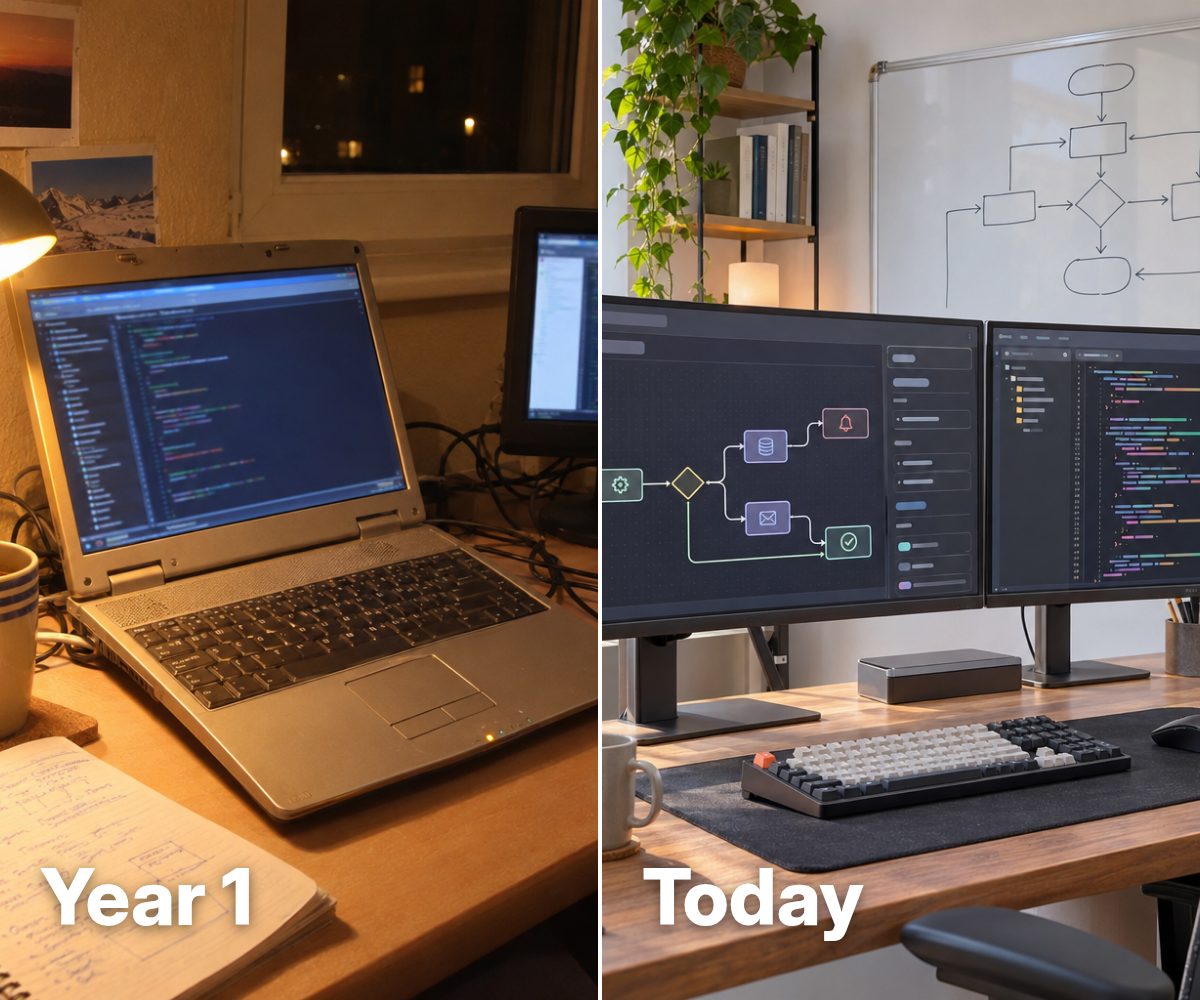
Made with: Higgsfield (GPT Image 2.6), AI-generated stand-in (both desk photos), labels added with the template
Source it mimics
Kevin Shim, 5.44x its creator's median (854 reactions + comments vs a median of 157). Posted Mon Oct 26, 2026, 10:31 AM CT. Format: 212 words, one image: two photos of him labeled Age 19 and Age 23.
Open the original post
Why it worked (our read): A one-line-per-year timeline reads in seconds, and every line is a small result. Then-and-now photos tell the story before anyone reads a word. It closes with a personal nudge, which pulls in comments from people thinking about starting.
What changed (the 10%): Same timeline shape, same closing paragraphs and the same 'take this as a sign' nudge. Ages become years in your career. His course plug becomes a one-line note on what you'll post about, because Phase 1 has no offer.
Needs your input:
- Fill the four year lines with true details
- Two real photos of you (then and now) to replace the stand-ins
- Keep or cut the optional Freshii line
Writing code was never the slow part
Post text
Writing code was never the slow part.

You can ship 50 pull requests in a week, but if you're building the wrong thing for the person using it, none of it counts.

Once you know you're building the right thing, that's when AI tools earn their keep: they speed up the delivery.

I always tell my employees: AI made the typing faster. It did not make the thinking faster.

That's the difference.
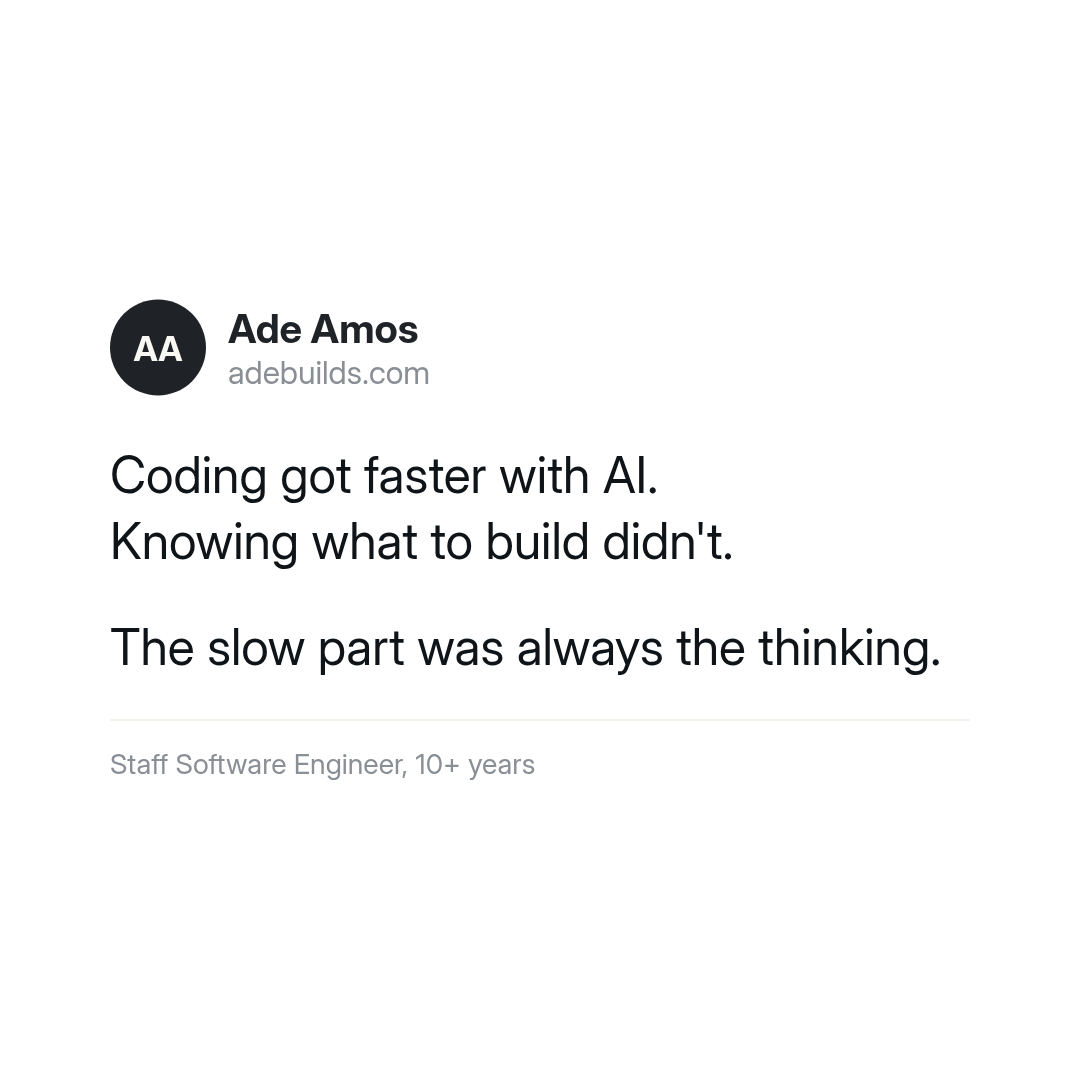
Made with: HTML/CSS template (diagram-styles/mockups style)
Source it mimics
Gregor Ojstersek, 9.36x its creator's median (1,194 reactions + comments vs a median of 128). Posted Thu Nov 12, 2026, 7:51 AM CT. Format: 74 words, one image: a screenshot of someone else's tweet backing up the point.
Open the original post
Why it worked (our read): One flat opinion on the hottest topic of the year (AI and coding speed), in 74 words. The screenshot adds a second voice agreeing. Engineers comment to agree or argue, and it is short enough to finish.
What changed (the 10%): Same 5 beats and length: flat line, 'you can write X, but if', 'once you know', 'this matters more', close. The second line uses pull requests instead of lines of code. The close is your 'I always tell my employees' line instead of his article link. The image is your own words, not another person's tweet.
Needs your input:
- Optional: post the card line on X first so the screenshot is real
Someone asked me to build [X]
Post text
[fill in: person in your life] asked me to build [fill in: small app]. [fill in: what it does, in one line.]

I said yes, on one condition: they'd try building their own version with AI first, and we'd compare.

[fill in: what happened when they tried. Keep it kind.]

I spent about [fill in: time] with [fill in: tools, for example Claude Code and Supabase] and ended up with [fill in: what you built and the 2 or 3 things it does].

They know [fill in: the problem / what looks good] far better than I do. The app is basically proof of that. What they didn't have was the right tool and a sense of what to ask for.

That second part is most of the work. AI can get you 70% to 80% of the way. Knowing what to ask for is the last 20%.

[fill in: one line of real-life color, like when they use it.]

So, did I help, or did I just prove a point?
Made with: HTML/CSS template (diagram-styles/mockups style) (placeholder)
Source it mimics
Ludovico Bessi, 5.10x its creator's median (306 reactions + comments vs a median of 60). Posted Sun Nov 22, 2026, 9:41 AM CT. Format: 199 words, two images of the app's screens.
Open the original post
Why it worked (our read): A small personal build with stakes people relate to, plus a challenge (she builds one too). It shows what AI did and what only the human could do, and ends on a playful question.
What changed (the 10%): Same setup, condition, comparison, build, insight and playful-question close. Lowercase becomes sentence case. His girlfriend becomes [person]. The insight becomes your 70% to 80% line.
Needs your input:
- Confirm a real personal project (not client, employer or agency work)
- Real screenshots
Fallback version
Use this if you don't have a personal build ready. It uses the content pipeline from your About section. Confirm it was your own build, not client work, before posting.
Post text
I wanted a content pipeline that didn't need me babysitting it. Research, drafting, review and publishing, all connected.

I gave myself one rule: no step ships without a check.

I built it with n8n and LLM APIs in [fill in: time].

What AI did well: [fill in: true detail].

What it got wrong: [fill in: the edge case it missed with total confidence].

The part AI couldn't do: deciding where a person has to look before anything goes out. That's why it has validation and cost tracking built in.

The demo took [fill in: an afternoon]. Making it something I trust every day took longer.

What's one thing you automated that you still check by hand?
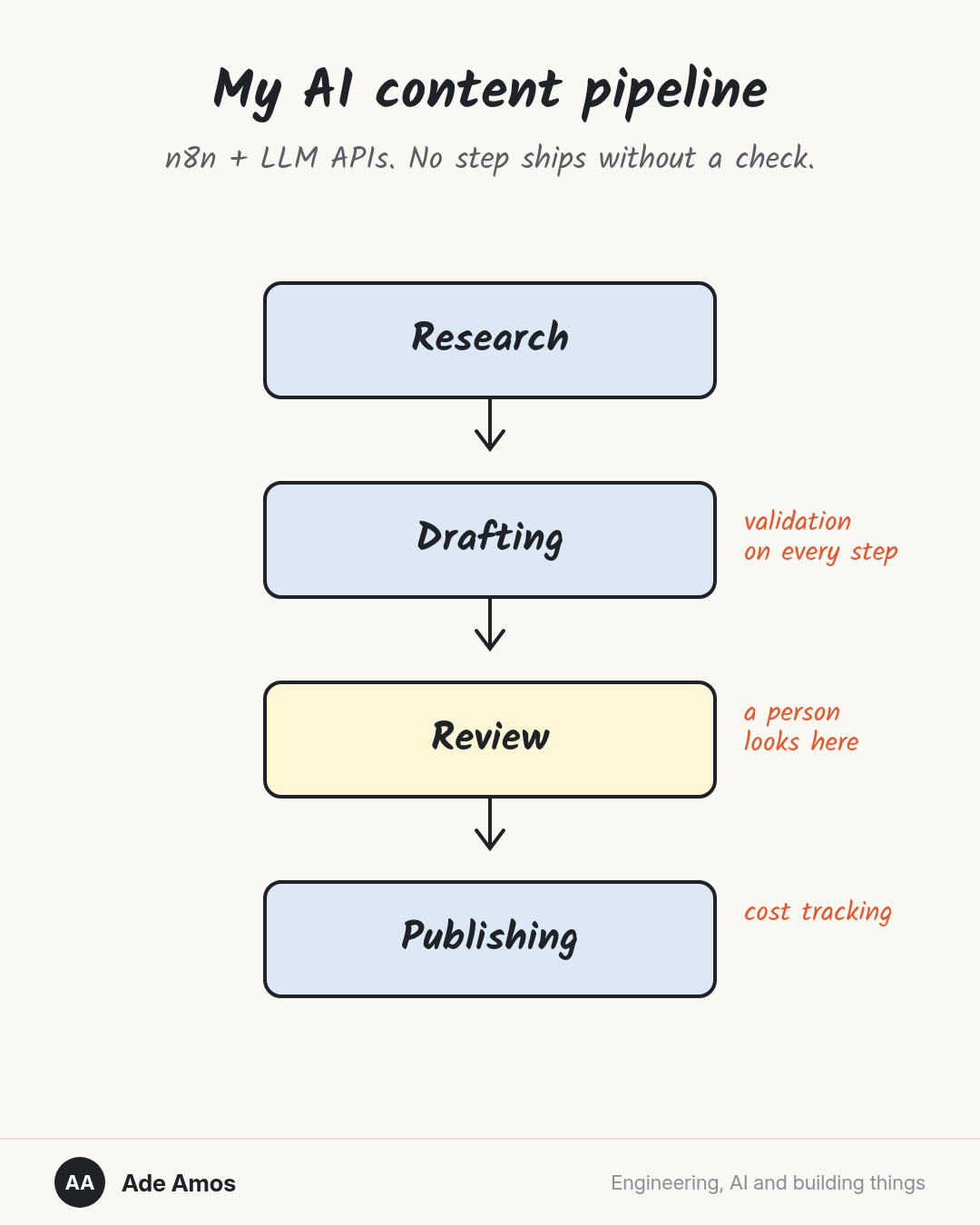
Made with: HTML/CSS template (diagram-styles/mockups style)
Nobody pays you to write code
Post text
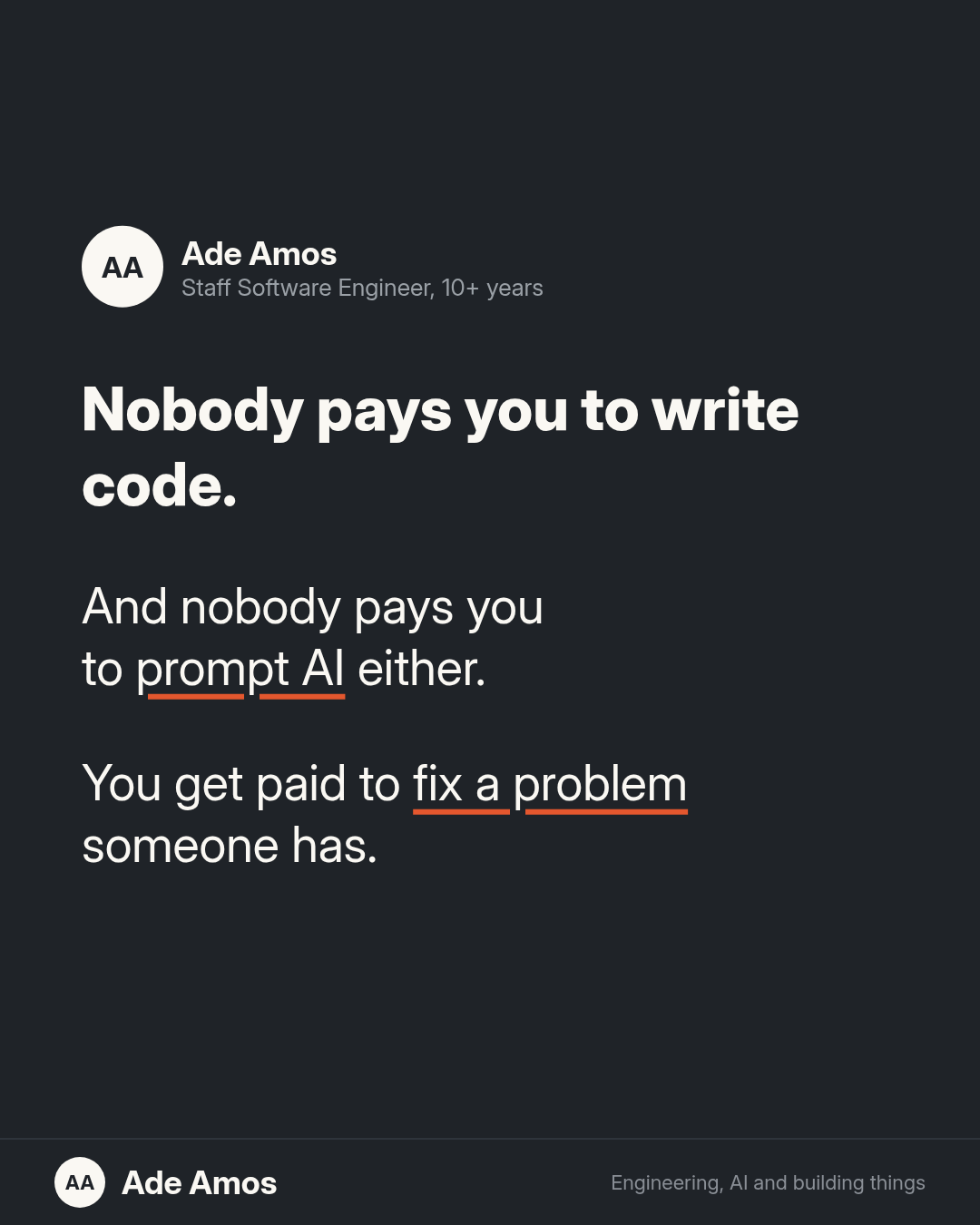
Nobody pays you to write code.

And nobody pays you to prompt AI either.

You get paid to fix a problem someone has.

Code is just the tool. AI is a tool too.

The person you're building for doesn't care if it took 2,000 lines or 200. They care that the problem went away, whether you typed it or the model did.

After 10+ years as an engineer, I keep seeing the same gap between people who grow fast and people who get stuck:

Shipping more features
vs. shipping the one people actually use

Picking the newest tool
vs. picking the tool that fits the problem

Generating code
vs. being able to tell if the generated code is right

Closing the ticket
vs. finding out why it keeps coming back

It works in the demo
vs. it works on a Tuesday with real data, alerts and a way to roll back

I always tell my employees: AI can get you 70% to 80% of the way.

The last 20% is edge cases, judgment and taste. It's what turns a piece of paper into a Picasso.

Tools change every year. Sometimes every few months.

Judgment travels with you.

Before you open the AI, ask 3 questions:

1. What problem does this solve, and for who?
2. How will we know it works?
3. What happens when it breaks at 2 AM?

AI can write a whole feature before your coffee gets cold.

It can't tell you if that feature should exist.

AI raises the bar. It does not remove the human.

What's one problem you solved that no AI could have solved for you?
Made with: HTML/CSS template (diagram-styles/mockups style)
Source it mimics
Anton Martyniuk, 4.05x its creator's median (2,236 reactions + comments vs a median of 552). Posted Sat Nov 14, 2026, 1:29 AM CT. Format: 411 words, one image: a black text card with his avatar and underlined phrases.
Open the original post
Why it worked (our read): A two-line punch hook that challenges the job title. Then a scannable list of 'this vs that' pairs people save, three questions to ask, and a closing question that invites stories. The black card repeats the hook, so it stops the scroll.
What changed (the 10%): Same hook pair, the same 'after N years I see the same gap' setup, contrast pairs, 'tools change', 3 questions and the closing question. The pairs are cut from 9 to 5, the emoji checkmarks become 'vs.', and your 70% to 80% line, the Picasso line and 'AI raises the bar' are added. His newsletter plug is dropped. The card uses your colors.
You can be good at your job and still run a business badly
Post text
You can be good at your job and still run a business badly.

I learned this the hard way.

When I owned a Freshii franchise, I thought I could engineer my way through it.

I'd been writing software for years. I knew how to build systems. I figured a restaurant was just another system.

And I still made mistakes that cost me [fill in: time / money / sleep].

A few of them:

↳ [fill in: mistake 1, for example a hire you kept too long]
↳ [fill in: mistake 2, for example a process you defended because you built it]
↳ [fill in: mistake 3, for example trying to do everything yourself]

The turning point?

[fill in: what changed, for example asking people who had run stores longer than you.]
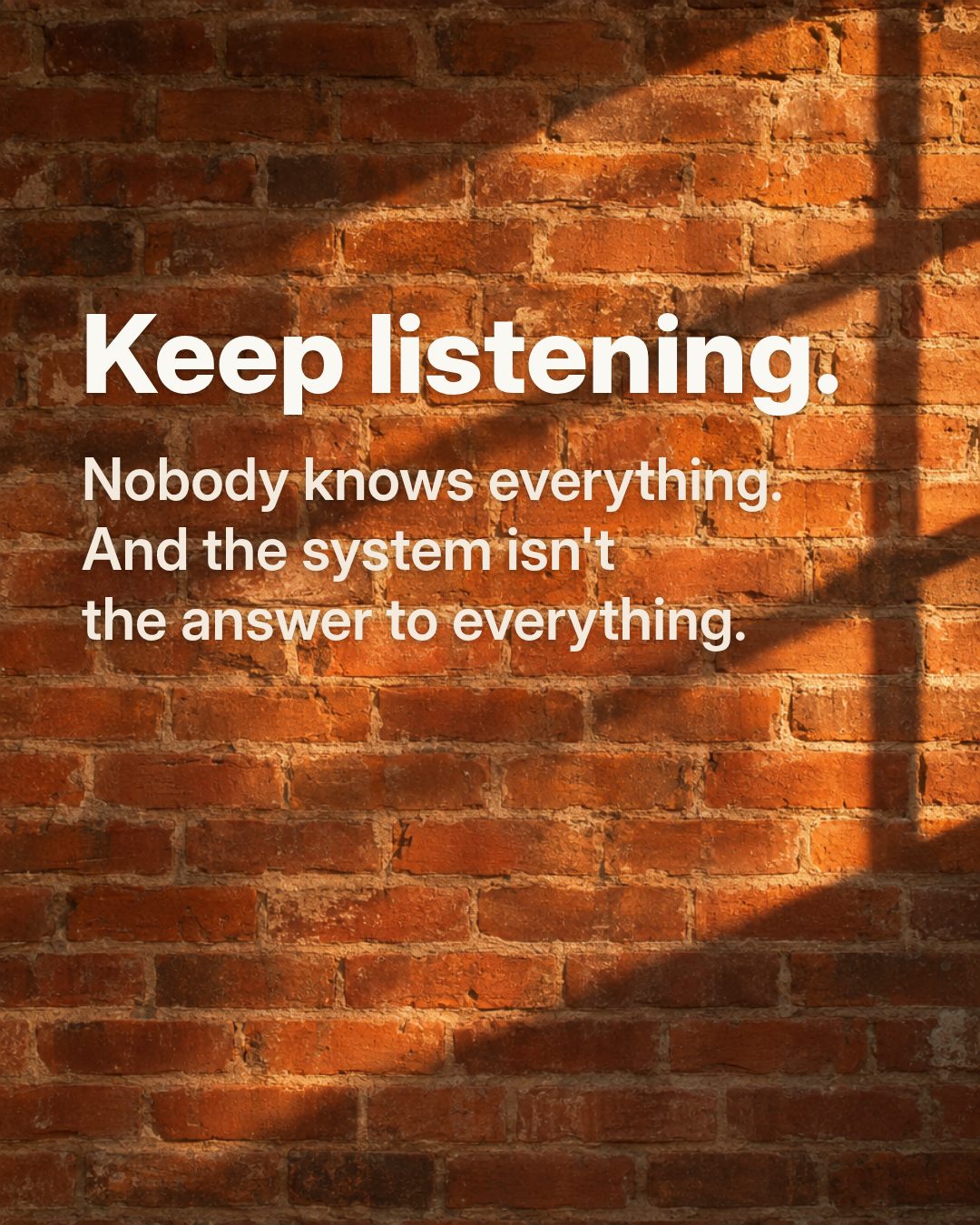
I stopped acting like the system was the answer to everything.

[Optional, already public on your profile: That's how we got to $1.2M in revenue within 24 months, and cut operating costs 17% by reworking store processes.]

The engineers who grow fastest aren't the ones with the most experience.

They're the ones who keep listening.
Who want to hear what's not working.
Who change it when it needs changing.

I've seen this on teams and in businesses.

Nobody knows everything.
I definitely didn't.
That's fine, as long as you keep listening.

What's a lesson you learned outside your job that made you better at it?
Made with: Higgsfield (GPT Image 2.6), AI-generated stand-in (wall), text added with the template
Source it mimics
Davis Nguyen, 32.71x (outlier; his next best lesson posts ran 8.0x and 7.25x) its creator's median (7,539 reactions + comments vs a median of 231). Posted Tue Nov 3, 2026, 7:00 AM CT. Format: 294 words, one image: text over a sunlit brick wall.
Open the original post
Why it worked (our read): A flat, universal first line, 'I learned this the hard way', credentials and then humility, three concrete mistakes, a turning point and a rhythm of short lines. The wall image repeats the lesson in a few words.
What changed (the 10%): Same skeleton line for line. His coaching business becomes your franchise. His Yale and Bain credentials become 'years writing software'. 'Stay teachable' becomes 'keep listening'. The repost and follow asks become a question.
Needs your input:
- Confirm you're OK telling the franchise story (unconfirmed)
- Fill the three mistakes and the turning point
- Keep or cut the public $1.2M and 17% line
Fallback version
Use this if you'd rather not tell the franchise story yet. It's the same shape, set on an engineering team, with no names.
Post text
You can be a good engineer and still build the wrong thing.

I learned this the hard way.

Early in my career, I thought if the code was clean, the project would take care of itself.

I knew the stack. I knew how to ship. I figured the rest was someone else's job.

And I still made mistakes that cost [fill in: weeks / a launch / trust].

A few of them:

↳ [fill in: mistake 1, for example building before asking who would use it]
↳ [fill in: mistake 2, for example defending a design because you wrote it]
↳ [fill in: mistake 3, for example not asking for help]

The turning point?

[fill in: what changed.]
I stopped acting like the code was the whole job.

The engineers who grow fastest aren't the ones with the most experience.

They're the ones who keep listening.

Nobody knows everything.
I definitely didn't.
That's fine, as long as you keep listening.

What's a mistake that made you better at your job?
Made with: Higgsfield (GPT Image 2.6), AI-generated stand-in (wall)
A workflow nobody uses is just an expensive demo
Post text
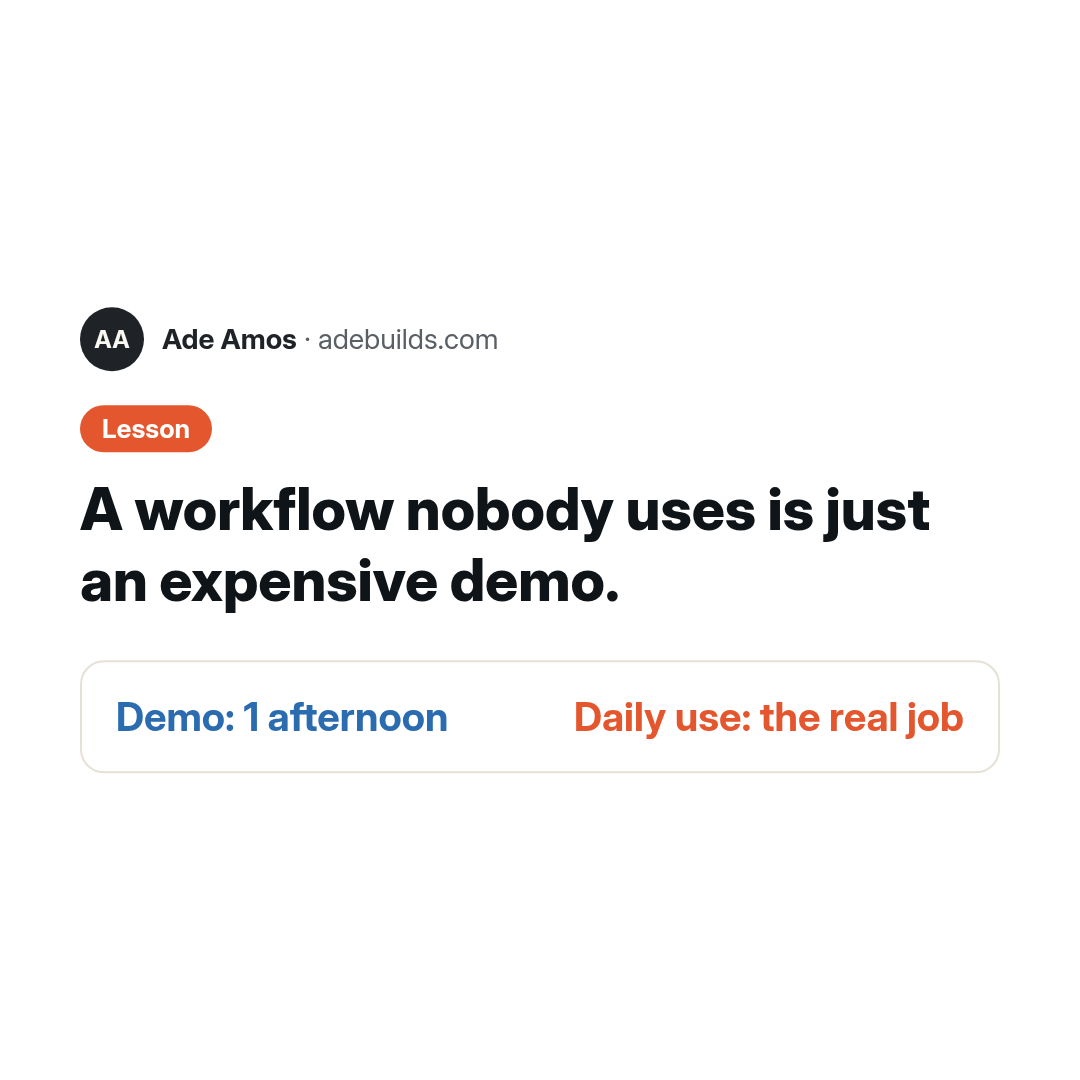
A workflow nobody uses is just an expensive demo.
Made with: HTML/CSS template (diagram-styles/mockups style)
Source it mimics
Gregor Ojstersek, 18.64x its creator's median (2,377 reactions + comments vs a median of 128). Posted Sat Nov 21, 2026, 7:01 AM CT. Format: 9 words, one image: a screenshot of a Reddit post.
Open the original post
Why it worked (our read): A 9-word opinion that engineers want to agree with, posted early on a Saturday when fewer people post. The screenshot is the proof, and the caption is the lesson.
What changed (the 10%): Same 1-line caption plus a post-screenshot image, posted at the same Saturday hour. The line is yours and about AI workflows, not code deletion. The image is your own card instead of a stranger's Reddit post. No emoji.
Engage only, plus the week 2 batch session
No post. Weekends carry about half the posting volume in both benchmark sets, and the median stays at or slightly below 1.0x. Saturday mornings can spike (Gregor 18.64x, Arpit 3.82x), so Saturday gets the light post and Sunday is for engaging.

Today:
- 20 minutes of real comments (3+ sentences) on Gregor Ojstersek, Raul Junco, Arpit Bhayani, Anton Martyniuk and Davis Nguyen.
- Batch session: read Mon Dec 7 to Sat Dec 12 out loud, fill every [fill in], and take the two photos (the sign for Sat Dec 12, and a then-and-now pair if Nov 30 used stand-ins).
- Log week 1 numbers for each post: reactions, comments, saves, profile views and new followers.
What did you ship last month?
Post text
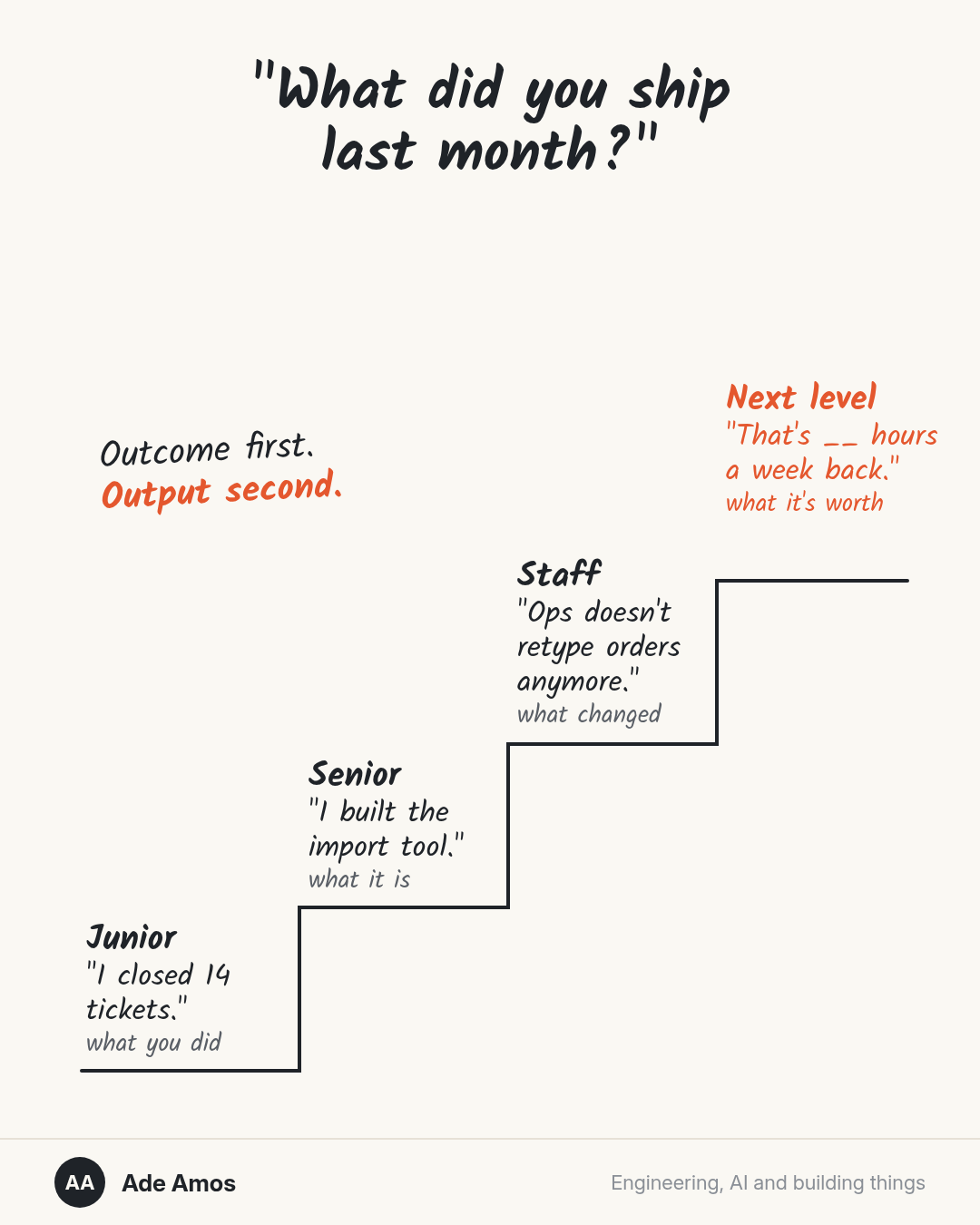
One of the fastest ways to tell how senior an engineer is: ask them what they shipped last month.

Junior engineers say "I closed 14 tickets."
Senior engineers say "I built the import tool."
Staff engineers say "Ops doesn't retype orders anymore."

Anyway. [fill in: a true moment, no names: someone, maybe you, explained their work as tickets or tools to a non-engineer, and it didn't land.]

[fill in: why it mattered, for example the project got cut, or nobody understood why it took 3 weeks.]

I'm not knocking anyone. I talked like that for years.

This isn't 2015 anymore. AI can write a lot of the code. So "what you did" is worth less every year, and "what changed" is worth more.

OK, here's the question people actually want answered:

"How do I explain my work so it lands?"

It comes down to two things.

First, the person. What do they care about? Time, money, fewer mistakes, getting home on time?

Second, the before and after. What did they do before? What do they do now?

Here's how each level changes the conversation:

What you did → they nod and move on
What it is → they ask what it does
What changed → they ask how you did it
What it's worth → they ask what else you can fix

Next time someone asks what you've been working on...

Don't list tickets.

Tell them what changed.

The rule I follow: Outcome first. Output second.
Made with: HTML/CSS template (diagram-styles/mockups style)
Source it mimics
Raul Junco, 2.34x its creator's median (438 reactions + comments vs a median of 187). Posted Mon Nov 9, 2026, 7:32 AM CT. Format: 374 words, one image: a hand-lettered decision diagram.
Open the original post
Why it worked (our read): The hook offers a quick test people want to apply to themselves. A three-level ladder sits right in lines 2 to 4, followed by a short story, the real question, a mapping list ('X → Y') and a two-part rule. The hand-drawn diagram gets saved.
What changed (the 10%): Same hook pattern ('one of the fastest ways to...'), the same three-level ladder, story beat, 'This isn't 20XX', 'here's the question', 'two things', arrow list, 'Next time... Don't answer...' and two-part rule. The database question becomes 'what did you ship'. The levels use your 4-levels idea. The diagram is a staircase in your hand-drawn style.
Needs your input:
- Fill the story beat with a true moment (no names)
Half the AI agents I see should have been a script
Post text
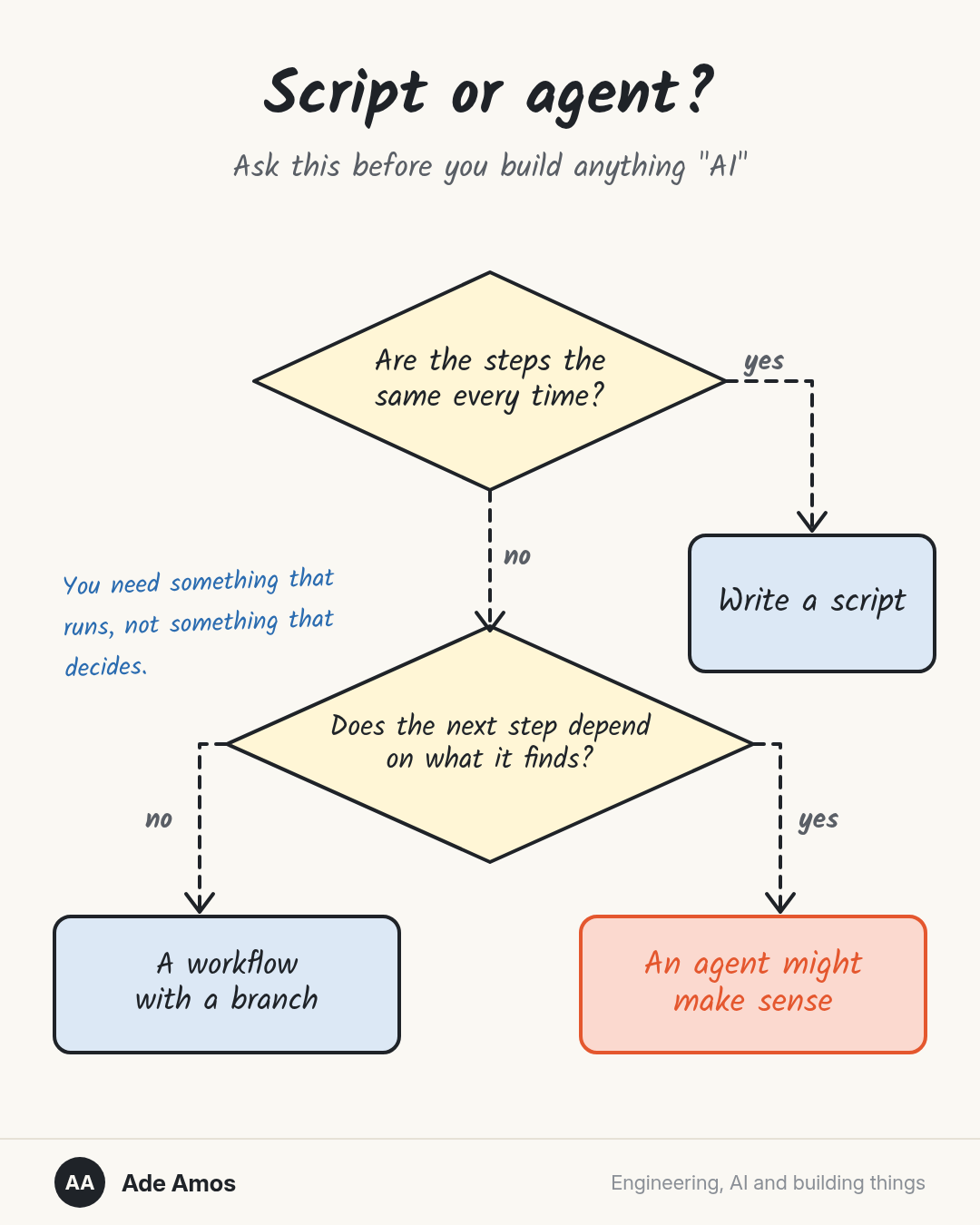
Half the AI agents I see should have been a script.
First comment
If you want the 30-second version of how I decide, here it is. [attach the Script or agent? image]
Made with: HTML/CSS template (diagram-styles/mockups style)
Source it mimics
Arpit Bhayani, 3.82x its creator's median (1,559 reactions + comments vs a median of 408). Posted Sat Nov 21, 2026, 6:37 AM CT. Format: 9 words, text-only, no image.
Open the original post
Why it worked (our read): One strong line that most engineers already agree with, so the comments fill up with people's own examples. Text-only works because the opinion is the whole post.
What changed (the 10%): Same one-line, text-only post. 'For god's sake, do not' becomes a calm observation (no preachy command). The decision flow goes in the first comment, so the post stays a one-liner.
Some of the things I've built
Post text
Some of the things I've built in the last 10+ years
Made with: HTML/CSS template (diagram-styles/mockups style) (placeholder)
Source it mimics
Nick Pattison, 10.18x its creator's median (1,909 reactions + comments vs a median of 188). Posted Sat Oct 17, 2026, 10:14 AM CT. Format: 14 words, one animated GIF cycling through the logos.
Open the original post
Why it worked (our read): The work speaks, so the caption is almost nothing. The animated collage holds people while it cycles, and every frame is proof.
What changed (the 10%): Same near-zero caption and collage format. Logos become your builds. Blur anything that belongs to a client or employer, and leave out agency tools.
Needs your input:
- 5 to 6 real screenshots of personal projects and adebuilds.com (unconfirmed)
Fallback version
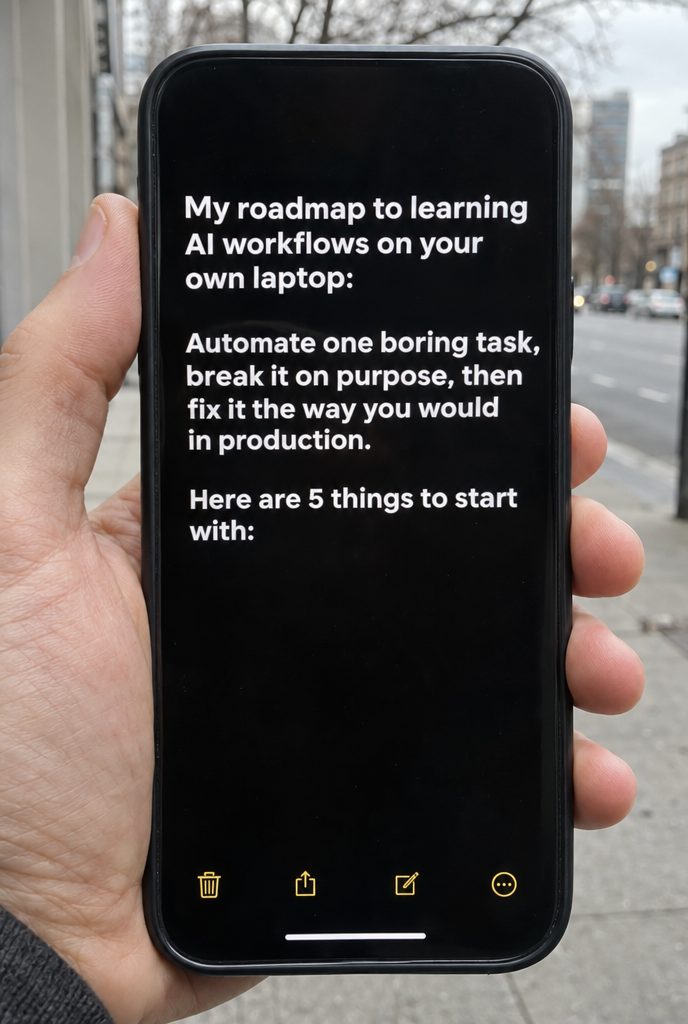
Use this if the screenshots aren't ready. It's modeled on Alexandre Zajac, 'My roadmap to learning distributed systems from your own laptop', 7.35x (529 vs a median of 72), Thu Nov 19, 2026, 10:32 AM CT, 229 words plus a photo of the note on a phone: https://www.linkedin.com/posts/alexandre-zajac_my-roadmap-to-learning-distributed-systems-activity-7529219960011730944-zx26 . It works because a roadmap promise plus 5 concrete starting points is very saveable, and the phone photo looks native. Confirm the 3 named resources are ones you'd recommend.
Post text
My roadmap to learning AI workflows on your own laptop:

Automate one boring task, break it on purpose, then fix it the way you would in production.

Here are 5 things to start with:

0. n8n
Pick one task you do every week. Build it as a workflow with a trigger, a few steps and an output. Nothing fancy.

1. Anthropic's "Building effective agents"
Read it before you build an agent. Most of the patterns in it are plain workflows, and that's the point.

2. Error handling
Turn off the API key and run it. What happens? Who finds out? Add a retry and an alert.

3. A person in the loop
Add one step where a human approves before anything goes out. Notice how much calmer you feel about it.

4. Evals
Write 10 test inputs and check the outputs every time you change a prompt. Hamel Husain's writing on evals is a good place to start.

You don't need to know every model or framework first.

Start with one thing that can go wrong: a timeout, a bad input, or an answer that's confidently wrong. Make it happen on purpose and see what your workflow does.

What's your learning path?
First comment
Links, so they don't sit in the post:
n8n docs: https://docs.n8n.io/
Building effective agents: https://www.anthropic.com/research/building-effective-agents
Evals: https://hamel.dev/blog/posts/evals/
Made with: Higgsfield (GPT Image 2.6), AI-generated stand-in
A plumber can make high six figures and never touch ChatGPT
Post text
I think a lot of us in tech forget why software pays the way it does.

It's not because code is magic. It's because the work is tied to a problem someone will pay to have fixed, and not many people can fix it.

I learned that outside of tech. I've owned a business, and I've bought businesses too. The ones doing well weren't the ones with the fanciest tools.

A plumber can make high six figures and never touch ChatGPT.

Why? [fill in: your read, for example the demand never goes away, they own the customer, and they show up when it's broken.]

Ask a plumber, an electrician or an HVAC owner you know (if you know one) how busy they are, what they charge for an emergency call, and how often a customer asks what software they use.

Software is a privileged field in a lot of ways. But the premium was never for typing. It was for being the person who can fix the thing that's costing someone money.

You think AI changes that? No. If anything, it makes it more obvious, right?

In some ways the job is the same as the plumber's: show up, find what's broken, fix it so it stays fixed.

That's the difference.
No image. The source was text-only, so this one is too.
Source it mimics
Gergely Orosz, 11.62x its creator's median (6,170 reactions + comments vs a median of 531). Posted Fri Oct 23, 2026, 6:54 AM CT. Format: 239 words, text-only.
Open the original post
Why it worked (our read): It takes an anxiety everyone has (AI and pay) and answers it calmly with reasoning. The 'ask your other engineer friends' line pulls comparisons into the comments. The close reframes what the job is.
What changed (the 10%): Same arc: 'I think many of us in tech forget why...', the real reason, 'ask your friends in other trades', 'privileged field, but...', and 'in some ways the job is...'. Other engineering fields become the trades, using your plumber line and 'I've bought businesses too'. His 'AI is another wave' becomes your rhetorical question with one 'right?'.
Needs your input:
- Fill the 'Why?' line with your own read
When I first led a team, I kept the hard work for myself
Post text
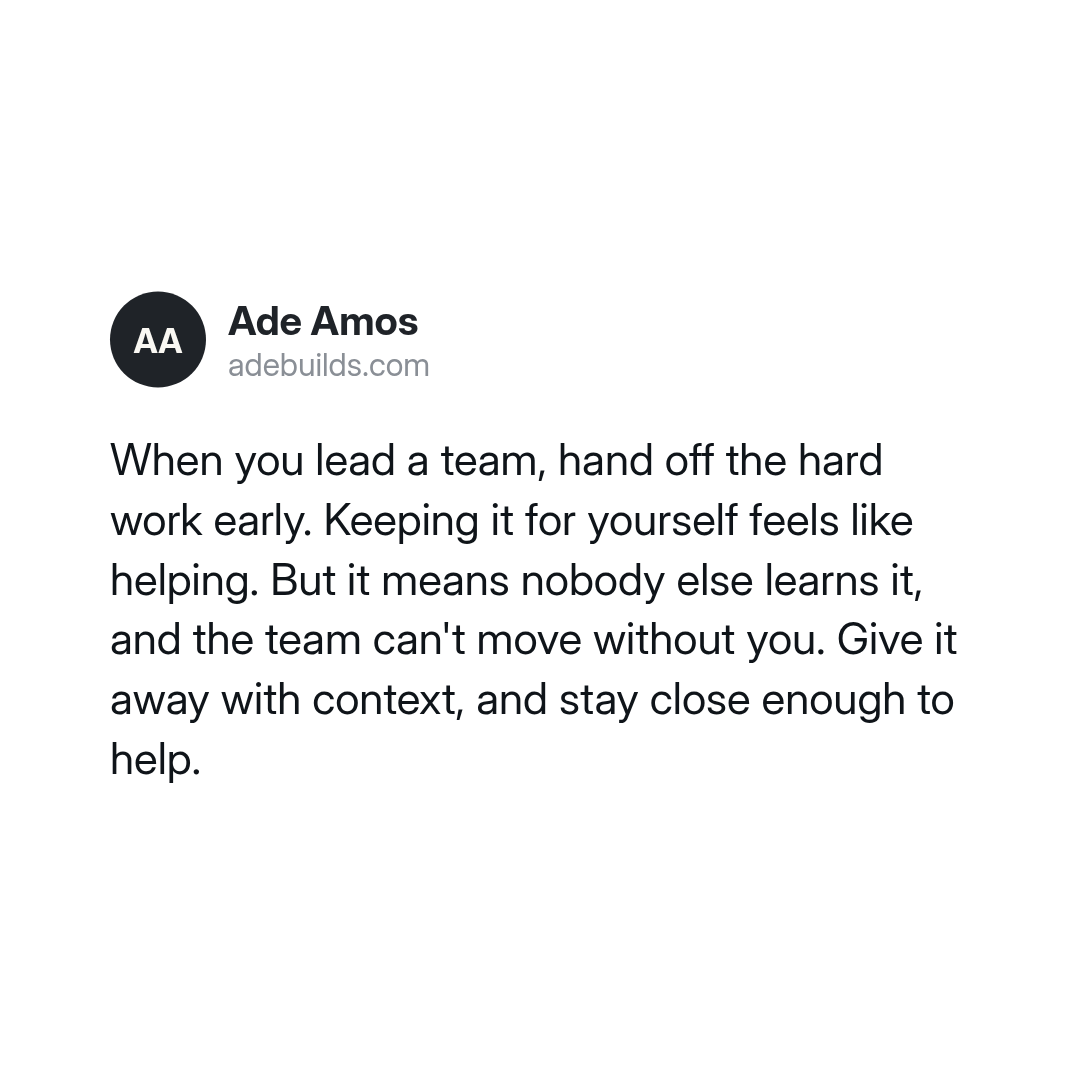
When I first led a team, I kept the hard work for myself.

The tricky bugs. The parts of the system only I understood. [fill in: one real example, no names.]

Instead of handing them off, I told myself I was protecting the team's time, and I took them on myself.

The problem is that this stops anyone else from learning the hard parts.

And when only one person understands the hard parts, the team can't move without them. That person was me. [fill in: what happened, for example a vacation that wasn't really a vacation.]

It's a lot better to hand off the hard work early, with context, and stay close enough to help.

When the team owns the hard parts, they get better faster, and you get to work on the next problem.

What did you have to stop doing to grow?
Made with: HTML/CSS template (diagram-styles/mockups style)
Source it mimics
Gregor Ojstersek, 8.38x its creator's median (1,068 reactions + comments vs a median of 128). Posted Sat Nov 7, 2026, 10:10 AM CT. Format: 164 words, one image: his own tweet as a card.
Open the original post
Why it worked (our read): A manager admits a mistake made for a good reason, explains why it backfired, and gives the better rule. The card restates the lesson, so the post works even if nobody clicks 'see more'.
What changed (the 10%): Same 'When I became X, I wanted to Y too much' admission, 'instead of', 'the problem is', 'it's a lot better to' and 'when the team...' beats. Shielding context becomes keeping the hard work. His article link becomes a question.
Needs your input:
- Fill the example and what happened (no names)
What's not OK is shipping code you didn't read
Post text
Using AI to write code is OK.

Not knowing every new tool is OK.

Asking the basic question in the meeting is OK.

What's not OK is shipping code you didn't read.

-Ade

Made with: Higgsfield (GPT Image 2.6), AI-generated stand-in
Source it mimics
Dan Martell, 14.06x its creator's median (5,384 reactions + comments vs a median of 383). Posted Fri Nov 20, 2026, 5:11 AM CT. Format: 29 words, one image: a photo of him holding a handwritten sign.
Open the original post
Why it worked (our read): 29 words in a rhythm: 'X is OK' three times, then a turn. A face plus one handwritten line feels human and reads in the feed thumbnail.
What changed (the 10%): Same 3 'is OK' lines, the turn and the sign-off. The topic moves from careers to AI and code. 'NOT' loses the caps (your voice). The sign says 'Read the code before you ship it.'
Needs your input:
- Take the real photo holding the sign (on Sun Dec 6)
Engage only, plus the Day 14 checkpoint
No post.

Day 14 checkpoint (moved here from Fri Dec 11):
- Log every post's topic, reactions, comments, saves, sends, profile views and new followers.
- Rank your own posts against your median, the same way we ranked the benchmark.
- Weeks 3 and 4: repeat the two strongest topics twice and drop the weakest.
- Mimic the next round of top posts from the benchmark creators (we can re-pull the last 30 days).
- 20 minutes of comments on the benchmark creators and your own engagers.